President John Mahama has recently boasted of a “shockingly quick” recovery in Ghana’s economy, noting inflation plunged from 23.8% to 5.4% and the cedi appreciated 37% in a year. He even claimed Ghana has become “a poster child for the IMF and World Bank” success story. In reality, however, this touted rebound rests largely on short-term fixes. The gains come from a heavy IMF-backed stabilization program – including massive debt relief – and an unusually strong external environment (especially high gold and cocoa prices) over the past two years. Under the surface, the economy remains under-capitalized and undiversified: industry beyond mining is stagnant, farming is under threat from illegal gold mining, and no new manufacturing engine has emerged. In short, the current upswing has not transformed Ghana’s economy. The real “turnaround” – meaning sustained, broad-based growth – will demand far deeper structural reforms than the government’s celebratory rhetoric suggests.
IMF program, debt relief and fiscal tightening
The headline improvements mainly reflect Ghana’s IMF bailout and related policies. Since May 2023 Ghana has had a $3.0 billion IMF Extended Credit Facility, which in turn has unlocked large debt relief and financing. For example, in mid-2025 Ghana’s parliament approved a $2.8 billion restructuring deal with 25 official creditors (including China, France, the US, UK and others). Under this agreement, all debt payments due through 2026 were rescheduled, effectively granting Ghana ~$2.8 billion in debt-service relief during the IMF program period. At the same time, IMF disbursements have flowed: as of late 2025 roughly $2.8 billion of the $3 billion package had been drawn. These funds and restructurings have eased Ghana’s financing crunch.
- Debt rescheduling: Official creditors agreed to delay and cap payments on ~$2.8 billion of Ghana’s external debt, yielding sizeable budget relief.
- IMF financing: The IMF program itself has disbursed nearly all of its $3 billion allocation to Ghana, providing crucial budget support.
- Fiscal consolidation: The new government sharply cut expenditures and boosted revenues. Ghana achieved a higher-than-planned primary surplus (~1.6% of GDP in 2025) and cut its overall deficit to about 3.2% of GDP (on target). Public debt fell rapidly – from about 61.8% of GDP at end-2024 to roughly 45.0% of GDP by October 2025 – thanks to the debt restructure, lower borrowing needs and currency appreciation.
- Commodity export boom: Robust gold and cocoa output produced a historic trade surplus. By Q3 2025 Ghana had a roughly $7.5 billion trade surplus (versus only $0.6 billion a year earlier). Foreign reserves swelled to about $11.4 billion (around 4.8 months of imports), providing a cushion for the cedi. These export windfalls – a “favorable external development” noted by the IMF – also helped rein in inflation and stabilize the currency.
Together, these factors have “yielded results” in macro indicators: inflation fell back into single digits, growth has accelerated, and the currency firmed. Indeed, the IMF press release on the fifth review (Dec 2025) observes that Ghana’s “macroeconomic stabilization is gaining momentum” after earlier policy slippages. Yet the Fund is careful to stress that these gains reflect both disciplined policies and external tailwinds. Its board statement explicitly warns that “continued reform efforts remain essential” to maintain stability and achieve true debt sustainability. In other words, Ghana’s progress so far is tied to the IMF program and windfalls – not yet to a re-engineered economy.
Why one year of growth isn’t a transformation
Ghana’s headline growth figures have indeed surprised many. Preliminary data show real GDP grew about 5.7% in 2024 and around 5–6% in early 2025, far above the 4% that the IMF had projected. But this rebound should be viewed cautiously. Most of the extra growth came from mining, construction and some services – sectors boosted by the recovery program and commodity prices – rather than from a broad-based surge in productivity. For example, industry sector growth (led by mining) averaged nearly 9% in early 2024, while manufacturing barely budged (~3.1%). Growth in agriculture was moderate, but it masked underlying stresses.
International institutions likewise counsel patience. The World Bank’s August 2025 Economic Update notes the economy “displayed resilience” with strong growth, but immediately cautions that fiscal strains in 2024 “undermined” stabilization gains. The Bank projects growth slowing to around 3.9% in 2025 as fiscal tightening cools domestic demand, and it flags major risks: any delay in completing debt restructuring or fiscal consolidation could throw Ghana off course. Ghana’s ministers “overshot” targets in 2024, the report warns, raising concern that overspending could return. In short, the early boost to growth may not persist unless policy discipline and reforms are sustained. As the World Bank puts it, Ghana’s “success will depend on maintaining reform momentum” – especially sticking to fiscal rules and overhauling loss-making state enterprises.
Similarly, the IMF stresses that current gains are partial. Its fifth-review statement notes that Ghana’s rebound was helped by “favorable external developments” (i.e. booming exports). It praises the drop in inflation and improved reserves, but also points out that reform implementation is still ongoing and that remaining structural “vulnerabilities” must be tackled. In other words, macro indicators look better, but underlying structures (business climate, public finances, energy sector, etc.) remain fragile. A one-year push has not resolved those.
The Gold Rush: Boon and Bane
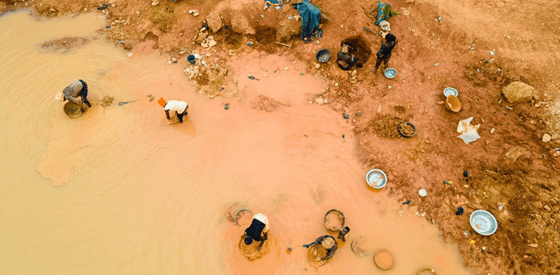
Gold has come to dominate Ghana’s economy: by 2023 it made up nearly half of all exports, and 2025 production hit record highs. This gold boom has flooded the treasury with FX and tax revenue, helping macro figures. But it has also had major downsides. A large share of the new gold output comes from informal “galamsey” mining – often illegal operations that ravage the environment. These small-scale miners use mercury and other toxins, and one estimate is that they have polluted about 60% of Ghana’s freshwater sources. They also dig up and flood farmland. Shockingly, Ghana’s cocoa sector – the world’s #2 – has already seen output cut roughly in half over the last 3 years because illegal gold pits are destroying cocoa farms. (In some regions over 70% of farms are affected.)
In short, the recent gains from gold come at a cost to other sectors and to sustainability. The economy’s reliance on gold makes it vulnerable to price swings and eventually to resource depletion. It also threatens to undermine rural livelihoods and food security by wrecking farms. Thus, while high gold prices have buoyed growth and reserves this year, they have not helped Ghana build a more diversified economy. On the contrary, other productive sectors (like cocoa and food crops) are being squeezed out by the gold rush.
Unchanged structure: neglecting industry and agriculture
Even with the current windfall, Ghana’s real economy shows little sign of transformation. The country remains heavily dependent on exports of raw commodities (gold, cocoa, oil), a situation sometimes called a “Guggisberg economy”. The manufacturing sector – which is essential for moving up the value chain – is tiny and stagnant. As one analysis notes, manufacturing’s share of GDP was only about 11.2% in 2023, the same as in 1970. No new industries are taking off to employ Ghana’s growing workforce. Agriculture (beyond cocoa) shows only modest growth and faces multiple constraints. Even within agriculture, the focus has not diversified: maize and rice remain low-yield; palm oil and other value-added crops are underdeveloped; and irrigation investments lag.
In effect, Ghana’s economy has not shifted toward higher-productivity sectors. Farmers, miners, traders and small vendors still make up the bulk of employment, many without formal contracts or social protections. As the World Bank emphasizes, true economic transformation requires moving workers into more productive jobs and expanding private-sector value chains. This means reforms to improve the business environment, address trade/logistics bottlenecks, and support manufacturing (e.g. textiles, electronics, agribusiness). So far, however, such reforms have been minimal under the new government. Electricity shortages persist, access to finance is limited, and informal firms face high barriers to scaling up.
Experts argue that achieving Ghana’s long-term goals will require concrete policy shifts rather than celebration of short-term metrics. For example, a recent policy study urged Ghana to adopt a national industrialization strategy (building small factories to add value to cocoa, timber, etc.), to reform energy supply so businesses can run 24/7, and to formalize the large informal sector (which employs ~80% of workers). Likewise, agriculture needs modernization: investing in irrigation and high-yield seeds, encouraging crop diversification beyond cocoa, and providing rural credit. None of these deep changes have yet materialized – they remain on the to-do list.
What a true turnaround would entail
An authentic economic turnaround would look very different from today’s snapshot. Instead of a single-year jump in GDP, it would show sustained growth in productivity and living standards across the board. Inflation and debt would be low and stable, underpinned by robust tax revenue and efficient spending. Crucially, growth would no longer hinge on one or two commodities: exports would increasingly come from manufactured and processed goods, and services would expand with skilled jobs.
Achieving that requires structural reforms. Economists suggest several key areas (summarized below):
- Diversification into manufacturing: Develop clusters of factories and processing plants (for example in textiles, food processing, chemicals) so Ghana can export finished goods rather than raw materials. This means improving logistics, resolving land issues, and attracting investment into value-added industries.
- Energy and infrastructure: Fix chronic power shortages and high electricity costs by upgrading the grid and inviting private-sector participation in energy production. Reliable, cheap power is essential for industry and services. Likewise, invest in roads, ports and irrigation to connect farmers and factories to markets.
- Formalizing business and labor: Bring informal enterprises and workers into the formal economy. Simplify business registration and extend tax incentives or social programs to small traders. Formalization raises productivity and government revenues.
- Agricultural modernization: Increase yields and resilience in farming. Move beyond staple rain-fed cocoa by investing in irrigation and high-quality seeds, and by promoting other crops (cassava, palm oil, poultry) that could be competitive. This would improve food security and rural incomes.
- Good governance and fiscal discipline: Enforce strict fiscal rules (as called for in Ghana’s 2018 Fiscal Responsibility Act) and tighten oversight of state enterprises and procurement. The World Bank and IMF both stress that solid public financial management is vital to prevent backsliding once the easy gains fade.
No single quick fix will deliver these outcomes. They require long-term political commitment and institutional change. Yet in private, many analysts observe that the government seems unprepared for the hard work ahead. By focusing on one-year “headline” victories, policymakers risk complacency. If debt-service obligations resume without continued consolidation, or if gold prices fall, the situation could reverse.
The road ahead: caution against complacency
In summary, the current boom in statistics should not be mistaken for a true turnaround. Ghana has certainly stabilized many of its urgent problems – inflation is down, the cedi is stronger, and the IMF program is broadly on track. However, those achievements mainly stem from the IMF program’s one-off measures (debt relief and tight fiscal/monetary policy) and from windfall export revenues. They do not reflect a fundamentally different economic model.
Observers warn that Ghana’s economy remains “undiversified, deindustrializing and vulnerable”. The President’s congratulatory tone overlooks this reality. As the IMF notes, Ghana must “stay the course of fiscal policy adjustment” and use the breathing space from debt deals to build long-term stability. Likewise, the World Bank stresses that without sustaining reforms, the hard-won gains will be fragile.
 Mind the GAP
Leave a comment