1. Introduction: The HON Mandate for Transparency
The HON Reports signify a definitive paradigm shift in Ghanaian accountability, moving beyond the era of opaque governance toward a future rooted in verifiable empirical evidence. In a landscape where political rhetoric frequently obscures the material conditions of the citizenry, the January 2026 edition serves as a critical diagnostic tool. It is designed to bridge the chasm between official narratives and the lived realities of the population, providing a rigorous baseline for national discourse.
The mandate of this report is codified in the HON acronym: Honesty, Objectivity, and Neutrality. As a statistical bulletin, it prioritizes unbiased data over political positioning, offering a transparent trajectory of Ghana’s economic, social, and political performance. By translating raw survey data and administrative records into actionable insights, this report equips stakeholders with the factual foundations necessary to dismantle misinformation and drive evidence-based policy. The following sections evaluate how these empirical findings define the current state of national progress.
2. Methodology: Framework for Empirical Oversight
Standardized metrics and independent oversight are strategic imperatives for dismantling the opacity that often shrouds West African governance. Without a rigorous framework, development data remains susceptible to institutional bias, undermining both investor confidence and civic trust. The HON methodology is designed to provide an impenetrable layer of integrity through five core components:
• Comprehensive Data Collection: Integrating national surveys, administrative records, and direct qualitative feedback to ensure insights are grounded in the actual experiences of diverse demographics.
• Public Accessibility: Ensuring reports are freely available via digital platforms, preventing the monopolization of information by political elites.
• Standardized Metrics: Establishing clear benchmarks for welfare and growth to allow for longitudinal tracking of progress.
• Independent Oversight: Utilizing third-party auditors and research institutions to validate data, ensuring that “Neutrality” is maintained even when reporting sensitive local grievances.
• User-Friendly Visualizations: Employing infographics to make complex datasets digestible for the general public, fostering broader engagement.
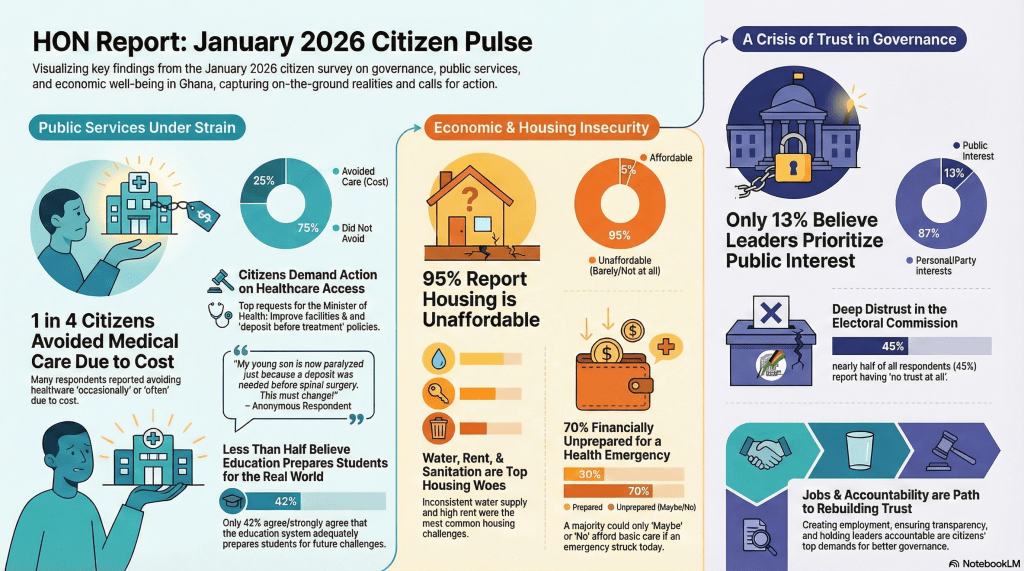
By adhering to these principles, the HON methodology ensures that specific citizen complaints—such as the explicit demands for the Minister of Health to “speed up construction” of the La General Hospital—are reported with clinical objectivity, providing a neutral mirror of the nation’s challenges.
3. Economic Performance: Employment and Resource Utilization
To assess true economic inclusivity, analysts must look beyond top-line GDP growth and evaluate how the workforce is actually utilized. The January 2026 data reveals an employment landscape characterized by high levels of public sector participation alongside a dominant, yet vulnerable, informal sector.
The following table summarizes the primary employment categories identified in the survey:
| Employment Category | Prevailing Status in January 2026 Data |
|---|---|
| Public Sector | High Representation; vocal about service delivery failures despite perceived stability. |
| Self-Employed | Dominant Category; includes artisans and small-scale business owners requiring capital. |
| Informal Sector | Significant prevalence; characterized by a total lack of social protections. |
| Private Formal | Moderate presence; primarily concentrated in urban hubs like Osu and Cantonments. |
| Unemployed | Notable concentration among youth and those in rural-to-urban transition. |
The overwhelming prevalence of “Self-Employed” and “Informal Sector” respondents highlights a severe structural bottleneck. The frequent citizen demand for “business capital” and “funds” found in the feedback indicates a systemic failure of the formal banking sector to reach the entrepreneurial base. This credit gap creates a cycle of low growth and limits the state’s tax revenue potential. Because the informal sector lacks social protections like employer-provided health plans, their reliance on the National Health Insurance Scheme (NHIS)—and the barriers found within it—becomes the primary determinant of national health outcomes.
4. Social Performance I: Health Outcomes and Access Barriers
Health metrics—specifically the ability to access care with dignity—serve as the ultimate indicator of government efficiency. While healthcare infrastructure exists on paper, the January 2026 data reveals that financial barriers effectively disenfranchise the majority of informal sector respondents.
Synthesis of citizen feedback regarding the NHIS and emergency services identifies three critical barriers:
1. Financial Barriers: Widespread avoidance of care due to the prohibitive cost of medications and services not covered by basic plans.
2. Insurance Gaps: A high frequency of “expired” or inactive NHIS memberships, coupled with a lack of “quality medicines” on the approved list.
3. Structural Delays (The “Deposit Before Treatment” Crisis): A pervasive and lethal grievance where facilities demand an advance financial deposit before commencing emergency care.
The “So What?” of this data is found in the harrowing qualitative feedback. One respondent reported that their “young son is now paralyzed just because a deposit was needed before spinal surgery.” Such incidents demonstrate that “financial gatekeeping” in healthcare is not merely an inefficiency but a human rights violation. Furthermore, the recurring demands for the “Minister of Health” to “rebuild the La General Hospital quickly” reflect a profound sense of regional inequity. Infrastructure serves as a hollow metric when life-saving care is predicated on immediate liquidity.
5. Social Performance II: Education, Literacy, and Digital Readiness
Aligning the educational curriculum with industrial needs is a strategic necessity for long-term national competitiveness. While school enrollment remains high across households, the quality of the intellectual environment is under severe scrutiny due to a lack of fundamental resources.
Citizen sentiment reveals a sharp contrast between enrollment and readiness. While teachers are “almost always” present, there is a chronic shortage of textbooks and a near-total absence of “digital learning tools.” The demand for “TVET” (Technical and Vocational Education and Training) and “Practical Learning” has surpassed the demand for traditional academic instruction. Citizens are explicitly calling for a “reduction of subjects/syllabus” to focus on skills relevant to the modern economy. Furthermore, the “Double-Track System” remains a primary point of contention, viewed by many as a compromise on educational stability that must be abolished to restore quality.
6. Infrastructure & Housing: The Urban Living Crisis
Housing affordability and utility reliability are direct determinants of civic stability. The data from early 2026 illustrates a population struggling with the exorbitant costs of urban rent and a chronic failure of basic water infrastructure.
“Inconsistent water supply and irregular access to clean water for daily sanitation.”
This verbatim grievance from the survey summarizes the primary infrastructure failure facing Ghanaian communities. Beyond water, the “High cost of rent” and “Improper sanitation” are identified as the most pressing challenges. The high interest in “Community Housing Cooperatives” with “pay-as-you-own” options is a rational market response to the “applied, rejected” status many reported regarding state-led housing schemes. It indicates a strategic shift where citizens are seeking collective, self-organized alternatives to a state apparatus that has failed to provide affordable shelter.
7. Political Performance: Governance, Trust, and Accountability
Trust is the essential currency of governance. The January 2026 findings suggest a catastrophic trust deficit, particularly regarding the institutions tasked with maintaining democratic integrity.
| Metric | Prevailing Sentiment |
|---|---|
| Trust in Leaders | Low; perceived prioritization of “personal/party interest” over public good. |
| Trust in Electoral Commission (EC) | “Not at all”; the most frequent response, indicating a crisis of legitimacy. |
| Awareness of Local Plans | Very Low; most citizens are entirely unaware of local development initiatives. |
The analysis of this deficit suggests that “Job Creation” has transitioned from a mere economic goal to the primary litmus test for political legitimacy. In the public consciousness, the government’s failure to provide employment and “business capital” is viewed as a breach of the social contract. To the Ghanaian citizen, “Transparency” and “Accountability” are no longer abstract values but are now measured by the tangible creation of economic opportunity.
8. Conclusion: Catalyzing Action for January 2026
The January 2026 HON Report highlights a critical disconnect: high participation rates in insurance and education systems are undermined by the poor quality and unaffordability of the actual services. This report serves as a baseline for urgent, evidence-based intervention.
Priority Action Items for Stakeholders:
1. For Policymakers: Immediately mandate a “Treatment Before Deposit” policy in all hospitals to end the human rights violations identified in emergency care. Prioritize the immediate completion of the La General Hospital and reform the curriculum to emphasize TVET and digital literacy.
2. For Investors: Direct capital toward FinTech solutions for micro-capital and informal sector lending. The data proves an overwhelming, unmet demand for funds among the self-employed that traditional banking has failed to address.
3. For Citizens: Leverage the data regarding the lack of “Local Development Plans” to demand greater transparency and involvement in community-level governance.
4. For Governance Bodies: The Electoral Commission must undertake radical transparency reforms to address the “Not at all” trust rating, as this level of skepticism poses a direct threat to social cohesion and democratic stability.
 Mind the GAP
Leave a comment