For a year, Ghana’s new rulers rode a glittering commodity wave. Now the wave is breaking, and the country will learn whether it has been swimming—or merely floating.
There is a particular kind of confidence that settles over a developing-country government in its first year of power when the numbers happen to cooperate. Inflation falls, the currency strengthens, the trade balance swings into surplus, and everyone involved—from the finance ministry to the central bank to the international lenders watching from Washington—allows themselves to believe that the turnaround is structural rather than circumstantial. That it reflects policy rather than luck. That the house being built has a foundation and not merely a favorable wind at its back.
In Ghana, that confidence has had roughly fourteen months to harden into something resembling a national narrative. When John Mahama and the National Democratic Congress returned to office on January 7, 2025, the country was still nursing the wounds of a debt crisis, a punishing domestic debt exchange, and the indignities of an International Monetary Fund program. By late 2025, the stabilization story had acquired three sturdy-looking pillars: year-on-year inflation had tumbled to 3.3 per cent by February 2026; the cedi had staged an extraordinary rally from roughly 15.5 per dollar to about 10.3, an appreciation so sharp it startled even optimists; and gold exports—swollen by record production and surging prices—had driven total exports to thirty-one billion dollars, delivering a current-account surplus of nine billion and international reserves of nearly fourteen billion. The I.M.F., in its December 2025 review, pronounced that stabilization was “gaining momentum,” buoyed by “robust gold and cocoa exports,” reserve accumulation, and a stronger cedi. The phrase amounted to an institutional pat on the back, though one delivered, as always, with a caveat about fragility and continued “policy discipline”.
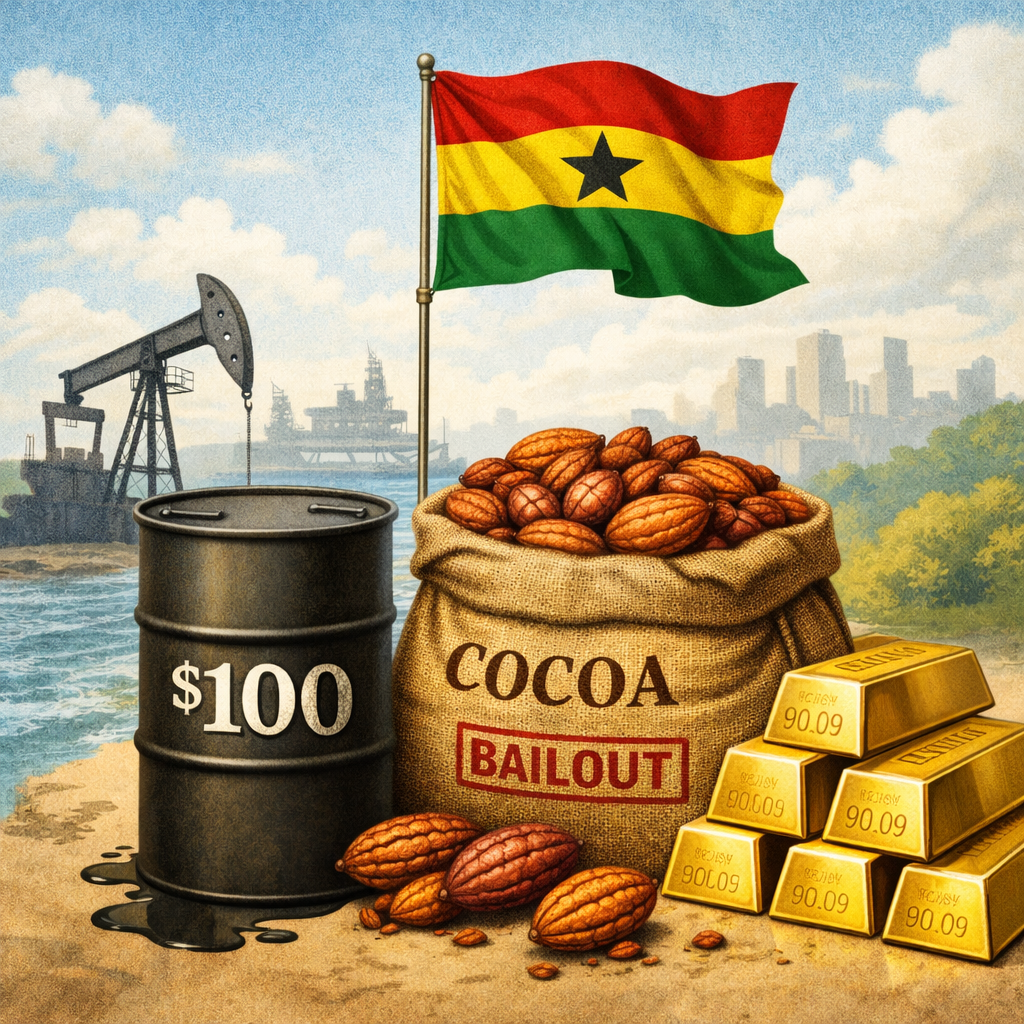
The caveat, it turns out, was the more important part of the sentence. Beginning next week, that careful architecture of macro reassurance faces a twin stress test whose components are, in the most Ghanaian of ironies, drawn from the very commodities that built the euphoria in the first place. Oil prices have surged past a hundred and eleven dollars a barrel on the back of an expanding conflict involving Iran and fears of disruption in the Strait of Hormuz. And the international price of cocoa, which Ghana’s marketing board had bet would remain near five thousand three hundred dollars a ton when it set the season’s farmgate price in October, has collapsed to around three thousand dollars—a halving that has broken the financing machinery of the cocoa value chain, stranded buyers, impoverished farmers, and forced the government into an emergency liquidity injection that may or may not reach the people it is meant to save.
What makes this moment consequential—beyond its immediate fiscal and social pain—is the argument it reopens. Because alongside oil and cocoa, there is gold. And gold, at record prices, is doing exactly what it has always done in Ghana’s political economy: tempting believers into a seductive and possibly ruinous thesis that the mineral can insulate the country from the cyclical misfortunes visited upon small, open, commodity-dependent economies by a world whose price signals they do not control.
A glance at the Bank of Ghana’s 2025 cumulative external-sector table tells you everything about the shape of the problem. Gold exports accounted for nearly twenty-one billion dollars of the year’s thirty-one billion in total exports—roughly sixty-seven per cent. Cocoa contributed about 3.9 billion. Oil brought in 2.6 billion. Everything else that Ghana produces and sells to the world—the manganese, the timber, the processed foods, the services—constituted a modest remainder.
Two structural realities emerge from these figures with uncomfortable clarity. The first is concentration: when a single extractive commodity generates two-thirds of your export earnings, you are not so much an economy as a price-taker with a flag. The second is that Ghana is a net oil importer on the trade ledger even though it produces crude—oil imports ran to five billion dollars in 2025, nearly double the oil-export receipts. That gap means every sustained move in the price of Brent is a first-order event for the balance of payments, the fiscal accounts, and, eventually, the price of bread.
What made year one look so clean was that all three commodity price winds blew in the same direction. Brent drifted down through 2025, reaching about sixty-two dollars by December—a tailwind for a net importer. International cocoa prices, though already falling from the vertiginous heights of early 2025 (above eleven thousand dollars a ton), were still high enough to deliver meaningful receipts. And gold surged relentlessly, pulling up export totals, the trade surplus, the current-account surplus, and—by extension—the reserves and the currency that everyone pointed to as evidence of a turnaround. This was not a recovery built on new factories, new export categories, or a reinvented domestic production base. It was a favorable alignment of externally determined prices, amplified by tighter foreign-exchange management and the discipline imposed by the I.M.F. program. The question now is what happens when the alignment breaks.
Oil moved from tailwind to headwind with the swiftness that characterizes geopolitical supply shocks. On March 9, 2026, Brent surged as high as a hundred and eleven dollars, driven by the expanding conflict between the United States, Israel, and Iran. For Ghana’s macro managers, the transmission channels are immediate and multiple.
The most visible is the import bill. With oil imports running at around five billion dollars in 2025 on a Brent average well below the current level, even a partial year of prices in the triple digits can add hundreds of millions—possibly more—to the cost of importing refined products. A second channel is inflation. Research by the Bank of Ghana itself models oil prices as an explicit driver in the exchange-rate-to-consumer-price transmission chain, with lags of several months. An oil-driven depreciation of the cedi, should it materialize, would ripple into CPI in the quarters ahead—threatening the 3.3 per cent inflation print that is, for now, the government’s proudest number.
Then there is the energy-sector fiscal sinkhole, a recurring Ghanaian pathology that high oil prices will only deepen. The I.M.F.’s staff report projects a 2026 energy-sector shortfall of roughly 1.1 billion dollars, and the budget has allocated fifteen billion cedis (about the same in dollar terms) to cover it. An oil shock above assumptions can blow through that provision quickly, because fuel costs for thermal generation and other energy payments rise in lockstep with the barrel. The energy sector has been a drain on Ghana’s public finances for years; at a hundred-plus-dollar oil, it threatens to become a haemorrhage.
The cocoa shock is, in some ways, more structurally revealing than the oil spike, because it exposes not just a price vulnerability but a design flaw in the very machinery through which Ghana markets its second-most-important export.
The system works—or worked—like this: Ghana and Côte d’Ivoire sell most of their cocoa forward, and the state board, COCOBOD, sets a fixed farmgate price at the beginning of the season in October. In October 2025, Ghana set its main-crop price at nearly fifty-three hundred dollars a ton. When futures then plunged to around thirty-one hundred dollars, the arithmetic turned lethal. International traders who had contracted to buy Ghanaian cocoa at the fixed price found themselves staring at losses if they sold at futures-linked levels. They pulled back. The buying pipeline seized. The International Cocoa Organization’s daily price confirms the scale of the rout: about three thousand dollars a ton in early March 2026.
What followed was a cascade that travelled from the international market through the domestic supply chain and into the banking system. Licensed Buying Companies—the private firms that purchase beans from farmers on COCOBOD’s behalf—owed banks between seven and eight billion cedis, roughly six hundred and fifty to seven hundred and fifty million dollars. They also owed farmers additional billions in unpaid purchases. The banks, still recovering from the domestic debt exchange that restructured their government-bond holdings, were in no position to absorb a fresh liquidity shock of this magnitude.
On March 3, 2026, COCOBOD announced it had released 3.62 billion cedis to the buying companies as part-payment of arrears owed to farmers, following a directive from the finance ministry. The headline figure suggested decisive action. The reality on the ground was less reassuring: Reuters reported that farmers and purchasing clerks remained unpaid despite the announced disbursement, fearing that the buying companies were using the money to service their bank debts rather than clearing the arrears they owed to the people who actually grow the beans.
The policy response has begun to shift from crisis management to structural redesign. In February, Ghana cut its farmgate price to about thirty-five hundred and eighty dollars a ton and introduced a new financing model centred on domestically issued cocoa bonds, with plans to legislate a formula linking farmer prices to international prices—including a stated minimum share of the free-on-board price. The government has also expressed ambitions to raise local cocoa processing to at least fifty per cent by the 2026/27 season. Whether these reforms arrive in time to prevent the current crisis from metastasizing into a rural-income disaster and a wider credit event is the more urgent question.
Gold and the Seduction of the Mineral Thesis
Against the backdrop of oil above a hundred and cocoa in free fall, gold stands as the obvious counterweight—and the obvious temptation. The 2025 external accounts show gold exports dwarfing everything else in Ghana’s trade portfolio, anchoring the trade surplus and the reserve-accumulation story that has underwritten the cedi’s strength. Ghana produced a record six million ounces in 2025, with artisanal and small-scale mining a large and growing driver. At current prices, the gold windfall is enormous, and its defenders will argue, not without data, that it is “the way out.”
This is the thesis that one might call the gold economic myth—the belief that because gold prices are high and production is rising, the mineral can serve as a permanent structural solution to Ghana’s recurring vulnerability to global commodity swings. The argument is empirically anchored in the near term: gold does, in fact, explain most of the 2025 macro stabilization. But it is analytically flawed in the medium and long term, for reasons that the current moment illustrates with painful clarity.
First, there is the question of who actually controls the gold supply chain. Ghana’s state-run artisanal exporter, GoldBod, was recently preparing contingency plans because around eighty per cent of artisanal and small-scale output is normally refined in Dubai, and flight disruptions to the United Arab Emirates threatened flows. The gold is Ghanaian; the refining, the pricing, and increasingly the logistics are not. When a flight cancellation to Dubai can create foreign-exchange implications for an entire country, the word “sovereignty” begins to ring hollow.
Second, there is the fight over value capture. Ghana has proposed replacing its flat five-per-cent gold royalty with a sliding scale of five to twelve per cent linked to prices. The response was swift and coordinated: multiple foreign governments, including the United States and China, warned that the upper bands could make Ghana one of the most expensive mining jurisdictions in the world and urged the government to halt the increase. The episode demonstrates an iron law of commodity dependence: even when prices are high and a country moves to claim a larger share of the windfall, international capital mobility and diplomatic pressure constrain how much value can actually be retained domestically.
Third, and most corrosively, there is the real-time competition between gold rents and the sustainability of other sectors. The I.M.F.’s own staff report notes that late-2025 cocoa pricing policy was designed in part to prevent cocoa farmland from being diverted into illegal gold mining. Two consecutive poor cocoa harvests have been linked to crop disease and weather, but the lure of galamsey—artisanal mining that poisons waterways and degrades soil—has been an accelerant. The gold boom does not merely mask fragility; it actively competes with the productive assets that might, over time, reduce dependence on extractives.
The anti-myth case, then, is not that gold is irrelevant to Ghana’s economy. It is that gold receipts can serve as a narcotic, dulling the urgency of the harder, slower, less glamorous work of building a domestic economy capable of producing, processing, and exporting goods and services whose prices and supply chains Accra can actually influence.
What “Building a Domestic Economy” Actually Means
It is easy to speak of economic diversification in the abstract. It is considerably harder to point to what it would look like in practice. The phrase has been invoked by every Ghanaian government since independence, and by every international institution that has published a report on the country, and it remains as elusive as it is rhetorically popular.
U.N. Trade and Development defines “commodity dependent” economies as those where more than sixty per cent of merchandise exports are commodities, and argues that such dependence “hinders economic resilience” and makes countries vulnerable to price volatility and external shocks. The World Bank describes Ghana’s economy as “not sufficiently diversified,” noting that gold, cocoa, and oil account for more than seventy-five per cent of goods exports, and that labour has shifted into low-value-added services while high-growth services employ few workers. The I.M.F.’s risk framework explicitly identifies commodity price volatility and geopolitical tensions as high-likelihood, high-impact risks, and its mitigation column reads like a policy wish list: “support domestic commodity production, processing (e.g., fuel refining), diversification,” and strengthened social protection.
In practical terms, the “build the domestic economy” imperative is not a slogan but a measurable set of shifts already visible, however tentatively, in current policy debates.
On energy and fuel, the arithmetic is straightforward: with oil imports exceeding oil exports on the trade ledger, reducing net exposure through domestic refining capacity is structurally valuable. Tema Oil Refinery announced in late December 2025 that it had resumed refining operations after a major maintenance turnaround. This is not a magic bullet—scale, reliability, and crude supply terms all matter—but it is a tangible example of domestic production that aligns with the I.M.F.’s own mitigation logic.
On cocoa, the crisis has revealed that the combination of a fixed farmgate price, forward sales, and limited financing flexibility can become a systemic weakness when prices collapse. The move toward domestic cocoa bonds, a legislative shift to link farmer prices to international prices, and a strategy to raise local processing capacity all represent the beginning of a redesign—one that the I.M.F. has framed as macro-critical in its emphasis on governance and oversight of state-owned enterprises.
On gold, the Dubai-refining chokepoint story is the clearest illustration of external control beyond price. Planning for local refining partnerships and traceability reforms is part of converting an export windfall into domestically anchored value capture, rather than the episodic foreign-exchange relief that evaporates the moment prices decline or logistics are disrupted.
Viewed this way, the debate between the gold optimists and the diversification advocates is not about whether gold matters. It is about whether a government that has been given a year of breathing room by commodity prices will use that room to build something durable—or will spend it basking in the flattery of favourable numbers.
The most revealing measure of whether Ghana’s stabilization is real or illusory will come from the next quarter’s data—specifically, whether the oil-and-cocoa shock triggers an immediate reversal of the stabilization triad: currency strength, low inflation, and reserve accumulation.
The Bank of Ghana’s interbank exchange-rate series provides the cleanest signal. Any sustained depreciation back toward the patterns of 2024 would suggest that the oil import bill and confidence effects are overwhelming gold receipts. An inflation re-acceleration from the current 3.3 per cent would be consistent with oil-price pass-through—directly through fuel and transport, or indirectly through a weakening cedi. A drawdown in reserves, which stood at roughly 13.8 billion dollars at year-end, while oil remains above a hundred, would signal the shock bleeding into external buffers. And the resolution—or non-resolution—of the cocoa arrears, with buying companies owing banks up to seven hundred and fifty million dollars and farmers still waiting for payment, will determine whether the cocoa crisis metastasizes into a broader credit event.
Behind all of these sits the question of I.M.F. program continuity. The Fund’s own documents emphasize that policy discipline and continued program implementation are the anchor for confidence and stabilization. Any slippage in reviews or disbursements during a commodity shock would magnify market pressure at precisely the worst moment.
For a year, the Mahama government has enjoyed the rarest of luxuries in Ghanaian politics: an economy whose headline numbers all pointed in the right direction at the same time. That luxury is now ending. What comes next will reveal whether the administration has been building on rock or on sand—whether the cedi’s strength reflects genuine domestic capacity or merely the shadow of a gold price that Ghana did not set, cannot control, and should not mistake for a national economic strategy. The house of cards metaphor is, perhaps, too dramatic. But the wind has picked up, and the cards are on the table.
 Mind the GAP
Leave a comment