John Mahama has spent fourteen months winning back Ghanaian trust. His brother Ibrahim is spending it faster than it can be earned.
There is an old joke in Ghanaian political circles, told with the weary affection of people who have been disappointed too many times to be surprised but have not quite given up hope: that every Ghanaian leader comes to office as a reformer and leaves as a cautionary tale. The second coming of John Dramani Mahama was supposed to be different. The man who lost power in 2016 under a cloud of economic collapse and whispered accusations of cronyism had, his supporters argued, been chastened. He had watched from the opposition benches as Nana Addo Dankwa Akufo-Addo proceeded to normalize — with serene unapologetic thoroughness — the very patronage networks he had campaigned against. The lesson, the argument went, had been learned. The corrective was at hand.
Fourteen months into his second term, the President has done genuinely impressive things. Inflation has fallen to 3.3 per cent. The cedi has recovered from the humiliation of near-sixteen to the dollar to something approaching dignity. The IMF has pronounced itself cautiously pleased. In his State of the Nation address in February 2026, Mahama spoke of choosing “discipline over waste, reform over excuses, stability over speculation” — language that would have seemed incongruous in the last years of his first term, and which Ghanaians, hungry for competence, have rewarded with an unusual degree of goodwill. The President, by most accounts, has carried himself with the demeanour of a man who understands the weight of the second chance he has been given.
And then there is his brother.
The Architecture of Proximity
Ibrahim Mahama is, by any fair accounting, a serious businessman. Engineers & Planners, the mining contracting firm he founded in 1997, has grown into the largest indigenous contract miner in West Africa, employing more than four thousand people and operating in Ghana, Liberia, and Sierra Leone. The company’s recent $205 million financing package, arranged by Stanbic Bank Ghana and Standard Bank of South Africa — with additional participation from Ecobank Ghana and Absa Bank — to expand operations at Gold Fields’ Tarkwa and Damang mines is, on its face, a straightforward commercial transaction between a successful African-owned enterprise and a consortium of major banks. Those who defended it said as much. The deal, they noted, was years in the making. The financing was merit-based. Ibrahim Mahama had built something real, and it would be a peculiar kind of paternalism to suggest that a businessman should be penalised for his brother’s election.
The problem is not Ibrahim Mahama’s balance sheet. The problem is the pattern.
In July 2025, barely six months after the NDC returned to power, E&P secured a $100 million facility from the ECOWAS Bank for Investment and Development to acquire the Black Volta Gold Project in the Upper West Region — the first large-scale gold mine in Ghana to be wholly Ghanaian-owned. The deal was celebrated with considerable fanfare in Accra, with the CEO of GoldBod — the government’s own gold trading regulator — in attendance at the signing ceremony. The Minority in Parliament was not celebrating. In a statement issued on July 29, 2025, the NPP caucus described what it called “state capture of the worst kind,” alleging that strategic appointments across the mining regulatory ecosystem had been engineered to benefit E&P. The statement pointed to the appointment of Sammy Gyamfi — a former E&P spokesperson — as CEO of GoldBod, the institution whose mandate includes overseeing the very sector in which Ibrahim Mahama’s company is the dominant indigenous player. It noted that the top executives of the Minerals Commission were also former E&P employees. “This is state capture of the worst kind,” the caucus said, “engineered and planned by the ‘engineers and planners’ of the NDC Government”.
The Presidency dismissed the allegations. The President himself has effusively praised GoldBod’s performance under Gyamfi’s leadership. And now, eight months later, Engineers & Planners is positioned as the leading candidate to acquire the Damang Mine, whose 30-year Gold Fields lease expires in April 2026, and which could sustain operations for at least nine additional years with capital investment of between $500 million and $600 million. The government has not yet formally named E&P as the successor operator — that process, requiring a mining lease and likely parliamentary approval, is still pending — but E&P’s letters, proposals, and engagements with Gold Fields and the Minerals Commission stretch back to September 2023, a record of strategic positioning that its defenders cite as proof of commercial foresight rather than political access.
Perhaps. But one does not need to allege criminality to observe that the convergence of regulatory appointments, financing windows, and asset acquisition opportunities around a single company owned by the President’s brother has, at minimum, created an environment in which the line between state promotion of indigenous enterprise and state capture on behalf of a presidential family is very difficult for the public to locate.
The Jet and What It Means
It is sometimes the small things that reveal the large truths. The presidential jet controversy, in isolation, is not a scandal of the first order. The state aircraft has been plagued by reliability problems; the Ghana Air Force has reportedly written to government recommending a replacement because of “frequent breakdown,” safety concerns, and operational inefficiency. The government says a new jet is being procured. In the interim, the President has been using a private aircraft owned by his brother for international travel — including, most recently, an official visit to South Korea. The government’s communications director has argued that the arrangement saves taxpayer money, since the pilots are on Ibrahim Mahama’s payroll and the state bears only landing charges.
The government’s defenders are not entirely wrong on the narrow economics. But they are badly wrong about everything else. The Member of Parliament for Walewale, Dr. Abdul Kabiru Tiah Mahama, put it with uncomfortable precision: “The potential conflict of using a private person’s jet for official trips is apparent. And now you are not using just any private person — you are using the president’s brother. The palpable conflict of interest is there.” Joe Jackson, the CEO of Dalex Finance and a commentator whose views cannot be easily dismissed as opposition noise, argued that while such arrangements can be acceptable in principle, the only way to avoid the appearance of conflict is through rigorous transparency: declaring the value of the service, the cost of running the aircraft, and the nature of the arrangement. That transparency has not been forthcoming.
What the jet story reveals is not corruption in the conventional sense. It reveals something more insidious: a cast of mind. A president who travels on his brother’s aircraft is a president who has decided, however unconsciously, that the ordinary protocols of separation — between the private interests of a presidential family and the public interests of the state — do not apply with quite the same force in his household. And once that threshold is crossed in small matters, it becomes progressively easier to cross in large ones. The critics who noticed that Ibrahim Mahama acquired his first private jet during his brother’s first term — and is now acquiring a second during the second — are asking a question that deserves a direct answer rather than a dismissal.
The Memory of the Thing
There is an additional dimension to all of this that Ghanaians would be right to weight heavily: it has happened before, and recently.
When the NDC was in opposition between 2017 and 2024, its communications director — one Sammy Gyamfi — was among the most voluble critics of what he and his party called the “family and friends government” of Nana Akufo-Addo. The NDC produced detailed dossiers listing more than fifteen relatives of the President appointed to key positions. It described Gabby Asare Otchere-Darko, the President’s cousin, as “the de facto Prime Minister” and “the most powerful man in the Akufo-Addo administration, second only to the President”. The language was scathing: “The Akufo-Addo/Bawumia government is the most nepotistic government in the 62-year history of Ghana,” the NDC said. The characterization was not without substance. Under Akufo-Addo, the concept of state-adjacent family enrichment was practiced with a brazenness that shocked even those who had come to expect it.
But the NDC’s institutional memory, it turns out, is shorter than its institutional rhetoric. The same Sammy Gyamfi who excoriated the family-and-friends model now heads the agency that regulates the sector in which his former boss’s brother is the dominant player. The President, who once benefited from the NDC’s righteous indignation about presidential jets and travel arrangements, now travels on his brother’s aircraft. The opposition, which should perhaps examine its own past before throwing stones, is nonetheless pointing at something real when it accuses the NDC of “double standards”.
Ghana has been through this cycle with enough regularity that it has almost become part of the constitutional furniture: a party arrives in office having spent years cataloguing the corruptions of its predecessors, proceeds to replicate them in its own idiom, and then expresses genuine bewilderment when the next opposition starts taking notes. The bewilderment, one suspects, is not entirely feigned. There seems to be something in the architecture of Ghanaian executive power — the concentration of discretionary authority, the weakness of arm’s-length institutions, the political economy of an extractive sector that generates vast rents — that produces these outcomes almost regardless of the personal intentions of the people involved.
The Structural Problem Behind the Personal One
The Ibrahim Mahama story is not, at its deepest level, a story about one businessman and his well-connected brother. It is a story about what happens when the state has not yet built the institutional architecture that allows it to credibly separate presidential family interests from national policy. UN Trade and Development has documented how commodity-dependent economies — those where more than sixty per cent of merchandise exports are primary commodities — are structurally vulnerable to the capture of resource rents by politically connected actors. Ghana’s gold sector, now generating over twenty-one billion dollars in annual export receipts and accounting for two-thirds of all goods exports, is precisely the kind of prize that attracts exactly this kind of proximity.
The government’s resource nationalism rhetoric — “we must be boldly selfish and claim a fairer share of our natural resource endowment,” the President said at the Africa Trade Summit in January 2026 — is not without intellectual merit. Ghana has, for most of its post-independence history, watched foreign companies extract enormous value from its subsoil while leaving relatively little behind. The aspiration to build indigenous mining champions is a legitimate policy goal. But there is a version of resource nationalism that serves the public, and there is a version that serves the President’s family. The difference between them requires institutional checks — transparent procurement, arms-length regulatory appointments, declared conflicts of interest, and an independent oversight architecture — that are visibly absent in the current configuration.
The Bank of Ghana’s governor has noted, in the context of rising Middle East tensions and oil prices, that “Ghana’s economy is growing faster than expected”. The World Bank’s managing director has praised the country’s economic turnaround. These are not hollow compliments. The macro stabilization of year one is real. But macroeconomic stabilization and governance integrity are not substitutes for each other. A country can have a strong current account and a captured state simultaneously. Ghana, in fact, has demonstrated this with some consistency.
The Test of Character
John Mahama has spent fourteen months persuading Ghanaians — and international creditors — that he understands the difference between a government and a family business. His State of the Nation address pledged to “intensify the fight against corruption with no sacred cows. Every cedi belongs to the people and must be accounted for.” These are not empty words, or at least they need not be. But they will be tested, and they will be tested here.
The test is not whether Ibrahim Mahama is a competent businessman. He may well be. The test is whether the President is capable of drawing, and then holding, the line between his brother’s legitimate commercial interests and the state’s obligation to govern without favour. That means transparent procurement for Damang and any future mining asset awards. It means arm’s-length appointments to regulatory bodies that oversee sectors where presidential relatives are active. It means, at a minimum, disclosing the full terms and value of every presidential trip on his brother’s aircraft. And it means accepting that even when these arrangements are technically defensible, they are symbolically corrosive in a country that has been told, again and again, by the man now in Jubilee House, that this time is different.
Ghanaians have heard the “this time is different” speech before. They heard it from Nana Akufo-Addo, who promised in 2016 that he would “not operate a family and friends’ government” — a pledge he proceeded to honour in the breach with such comprehensive dedication that the NDC was still listing his relatives in government dossiers years later. The capacity of Ghanaian politicians to believe, sincerely and even eloquently, in their own exceptionalism is one of the more durable features of the country’s political culture.
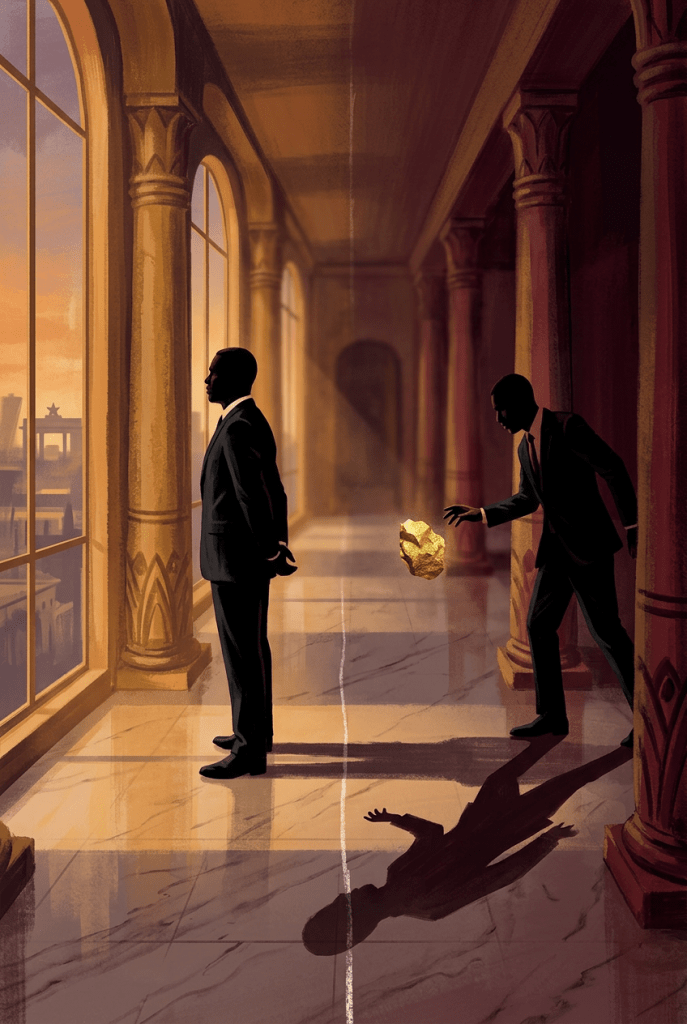
The Jekyll-and-Hyde metaphor is apt, but its geography needs to be clear. The President and his brother are not the same person. The danger is not that John Mahama has a villainous alter ego. The danger is that two people — one holding the powers of the state, the other deploying those powers’ proximity for commercial advantage — have allowed their interests to blur in ways that, left unaddressed, will compound into something that looks, from the outside, indistinguishable from the thing that Ghanaians voted in January 2025 to put behind them.
 Mind the GAP
Leave a comment