At a moment of rare geopolitical leverage, Ghana chose symbolism over strategy. The ancestors deserved better. So did the living.
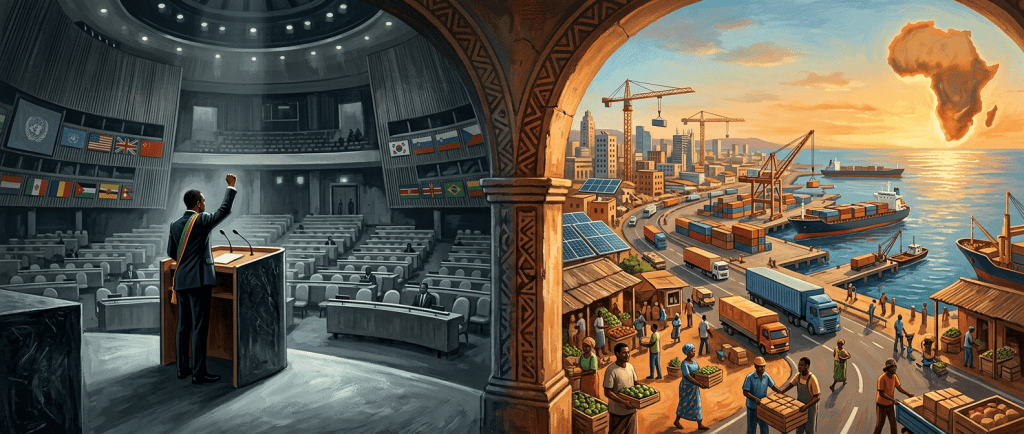
On the morning of March 25, 2026, John Dramani Mahama stood in the hall of the United Nations General Assembly and said something that was, by any measure of historical conscience, absolutely true. The transatlantic slave trade — the forced removal of between twelve and fifteen million men, women, and children from the African continent across four centuries — was, he declared, “the gravest crime against humanity.” The applause that followed was genuine. The 123 votes in favour of the resolution he introduced, against only three opposed, represented the largest affirmation the international community has ever given to this truth. The United States, Argentina, and Israel voted no. All twenty-seven European Union members and the United Kingdom abstained.
The moral case was sound. The diplomatic theater was flawless. And the strategic timing was, arguably, the most expensive miscalculation Ghana has made in a generation.
The Resolution and Its Limits
Let us be precise about what Ghana achieved on March 25. The resolution — backed by the African Union, CARICOM nations, Brazil, and more than a hundred and twenty other states — formally declares the transatlantic slave trade the gravest crime against humanity, calls on member states to contemplate apologies and contributions to a reparations fund, and requests the return of cultural artefacts to their countries of origin. It does not specify any financial amount. It does not create a binding legal obligation on any state. It cannot be enforced. Unlike resolutions of the Security Council, General Assembly resolutions carry no legal compulsion whatsoever — they reflect, as the BBC noted of this specific vote, “significant global sentiment,” but nothing more.
Ghana’s foreign minister, Samuel Okudzeto Ablakwa, was admirably candid about what the resolution is not. “We are not demanding compensation,” he told journalists after the vote. “We seek justice for the victims and support for causes, including educational and endowment funds, as well as skills training funds.” The Global Group of Experts on Reparations, which helped strengthen the legal language, has proposed a Financial Transaction Tax as a possible financing mechanism. There is no mechanism, no timeline, no enforcement architecture.
Scholars of international law have been observing for decades that UN reparations commitments without mandatory funding are not reparations — they are, as Harvard Law’s International Human Rights Clinic put it in a study of the institution’s own record, “symbolic gesture only and not a practical method of redress for victims.” The Netherlands has offered a formal apology for its role in slavery and stands as the sole European nation to have done so; no financial transfer has followed. UN Secretary-General António Guterres himself called for “far bolder actions” in addressing the pillaging of African resources — language that, one suspects, was chosen precisely because he knows that the resolution will not, on its own, produce them.
None of this is to say that the moral and historical affirmation is without value. It is to say that Ghana — the first sub-Saharan African country to achieve independence, the headquarters of the African Continental Free Trade Area Secretariat, the country led by the man named the African Union Champion for Reparations — has spent its most concentrated diplomatic energy, at one of the most consequential geopolitical moments in the post-Cold War era, on a resolution that everyone already knows will not be implemented by the countries whose implementation matters most.
The Window That Is Closing
To understand what is being foregone, it is necessary to describe, with some precision, the world that currently exists around Ghana.
The United States, China, the European Union, and Russia are engaged simultaneously in military conflict (in Ukraine and the expanding Middle East theatre), economic warfare (tariffs, sanctions, supply-chain decoupling), and the most intense competition for African resources, infrastructure, and political alignment in modern history. China’s trade volume with Africa stands at four times that of the United States — two hundred and eighty-two billion dollars against seventy-two billion — and Beijing has recently announced a new push to strengthen African partnerships explicitly in response to strained US-Africa ties under the Trump administration. American disengagement from Africa, including the dismantling of USAID and the abrupt freezing of development assistance, has created a vacuum that multiple powers are rushing to fill.
For African governments, this competition is not a threat — it is, as the Atlantic Council’s Africa Center put it in its 2026 assessment, a historic opportunity. IMF projections show African economic growth in 2026 expected to exceed that of Asia for the first time. Fifty countries have ratified the AfCFTA agreement, the world’s largest free trade area by number of participating nations, connecting 1.4 billion people across fifty-five countries with a combined GDP of approximately 3.4 trillion dollars. The AfCFTA Secretariat sits in Accra. Ghana is, by institutional geography and recent diplomatic history, better positioned than any other single African state to act as the convening power for a new architecture of Southern multilateralism.
The model for what this could look like is not without precedent. In April 1955, twenty-nine newly independent or soon-to-be-independent nations gathered in Bandung, Indonesia, for the Asian-African Conference — a meeting that had no equivalent in the post-war world because it happened entirely without the great powers, and entirely on terms that its participants set for themselves. The Bandung Spirit gave rise to the Non-Aligned Movement, the G77, and decades of developing-nation solidarity that, for all its limitations, gave the Global South a negotiating weight it had never previously possessed. It was conceived in a world of Cold War bipolarity. Today’s world offers a more complex variant of the same structural opportunity: great powers entangled in their own conflicts, Africa sitting on the critical mineral reserves that every one of them needs, and an institutional framework — the AfCFTA — capable of being the economic backbone of a new coalition of the lesser powers.
Mahama himself has articulated exactly this analysis. Speaking at the Africa Trade Summit in Accra in January 2026, he warned that Africa’s “long-standing dependence on exporting raw materials while importing finished goods had left the continent vulnerable to external shocks and trapped in low-value economic activities,” describing the model as “a neo-colonial arrangement that perpetuated poverty.” He called for “manufacturing and agro-processing” to “create jobs, raise incomes, deepen skills, and anchor inclusive growth.” He said, with notable directness, that “political independence without economic transformation remained incomplete.” This is not the language of a leader who lacks the intellectual framework for strategic multilateralism. It is the language of a leader who understands exactly what is at stake — and who then flew to New York and spent the continent’s diplomatic capital on a UN resolution that the United States and every EU member either opposed or refused to support.
The Counterfactual Ghana Chose Not to Pursue
What would a strategically coherent use of Ghana’s current leverage look like?
The AfCFTA’s own Secretary-General, Wamkele Mene, has noted that as of late 2024, the Guided Trade Initiative had expanded from seven to thirty-nine countries actively trading under the agreement. Despite this progress, intra-African trade accounted for just 11.8 per cent of total trade among eleven major African economies in 2023 — a share that has declined, not grown, since the agreement entered force. The structural barriers are well-documented: inadequate infrastructure, non-tariff trade barriers, low awareness among businesses, and insufficient financing for regional value chains.
These are not abstract development challenges. They are negotiating opportunities. In a world where the United States is restructuring supply chains away from China and desperately needs alternative mineral suppliers, where China is removing tariffs to strengthen African partnerships, and where the Gulf states are deploying sovereign wealth funds across the continent — the country that sits at the institutional centre of the world’s largest free-trade area and convenes a serious coalition around implementation, infrastructure financing, and value-addition policy has the attention of every major power simultaneously.
The Bandung Conference of 1955 did not succeed because Nehru, Nkrumah, and Sukarno spent their energy litigating the historical crimes of colonialism in multilateral forums where the former colonial powers held veto power. It succeeded because they built something — a new diplomatic grammar, a new set of bilateral and multilateral commitments, and a new framework for collective leverage. Kwame Nkrumah, whose legacy is the intellectual foundation of Ghana’s foreign policy identity, spent his most creative years not presenting resolutions that Britain and France would ignore, but organizing the All-African People’s Conference in Accra in 1958 and laying the groundwork for the Organisation of African Unity in 1963. The instrument was solidarity; the goal was structural power.
What Ghana could be doing — what it should be doing — is convening a new version of that architecture, this time with economic integration as its core, the AfCFTA as its institutional spine, and the strategic leverage of African mineral wealth as its negotiating currency. The Atlantic Council has observed that in 2026, “African countries will need to work harder to seize these opportunities” around geopolitical turbulence, reforming multilateralism, and relaunching partnerships on terms that serve the continent’s priorities. The critical-mineral competition between the US and China over Congo, Zambia, and Ghana’s own subsoil is a daily illustration of how much leverage Africa actually holds, and how rarely it is used collectively.
The Complexity That Deserves Acknowledgement
It would be dishonest not to acknowledge the counter-argument, and it is not a trivial one. Ghana’s foreign minister argues that the reparations resolution is not about “reopening old wounds; it is about ensuring that those wounds are neither forgotten nor denied.” There is a strand of thinking — present in academic international law, in African Union strategy documents, and in the diaspora advocacy community — that frames the reparatory justice campaign not as a distraction from economic strategy but as an integral part of it: a demand for “a shift in power, not charity,” for “financial transfers and the correction of power,” for the dismantling of systems that “continually penalise Africa.” The AU has designated 2026-2036 the Decade of Reparations, and the argument is that building the legal and political architecture of a reparatory claim is itself a form of long-term strategic investment.
This argument deserves to be engaged, not dismissed. The transatlantic slave trade was, by any standard of historical reckoning, an economic event as much as a moral one. The labour extracted, the capital accumulated, the industrial revolutions enabled by the proceeds of enslaved African bodies — these were not merely crimes of conscience. They were the original transfers of wealth that the current distribution of global economic power still, in significant part, reflects. To say that Africa should not demand an accounting is to accept the permanence of a theft.
But the accounting, if it is ever to come, will not come from a non-binding General Assembly resolution that the United Kingdom abstained from and the United States actively opposed. It will come — if it comes at all — from a transformed global power architecture in which Africa wields sufficient economic and political leverage that the former colonial powers calculate it is in their interest to negotiate. That architecture is not built in the UN General Assembly hall. It is built in trade agreements, industrial policy coalitions, and the kinds of diplomatic relationships that Mahama could be forging right now, with the wind of a multipolar world at his back and the AfCFTA Secretariat in his capital city.
The question is not whether Ghanaians are owed something. They are. The question is whether this is the most effective use of the tools and the moment available to press that claim. A lawyer who spends a trial making speeches about the injustice of the system rather than building the legal argument that might actually win is not being more righteous than one who builds the case. He is simply losing.
The Nkrumah Standard
Ghana’s foreign policy identity is inseparable from Kwame Nkrumah. It was Nkrumah who said, in 1957, that Ghana’s independence was “meaningless unless it is linked up with the total liberation of Africa.” It was Nkrumah who understood that the continent’s greatest vulnerability was the fragmentation that allowed colonial powers to extract from a unified resource base through divided, dependent states. It was Nkrumah who spent his political genius not on symbolic victories but on structural ones — the OAU, the pan-African economic framework, the vision of a continent that traded with itself and spoke with one voice to the world.
The Nkrumah standard is not rhetoric. It is architecture. And the irony of the present moment is that Ghana has, for the first time in decades, the institutional position, the diplomatic profile, and the geopolitical context to build something that Nkrumah would have recognized as worth building. The AfCFTA is headquartered in Accra. Ghana hosts the Africa Trade Summit. Its president is the African Union’s champion — not for trade, not for economic integration, not for AfCFTA implementation, but for reparations.
The ancestors who were taken from these shores in chains did not survive the Middle Passage so that their descendants could achieve a non-binding UN resolution that fifty-two nations refused to vote for. They survived, when they survived, so that Africa might one day have the power to extract justice from a transformed world order rather than petition for it from the old one. That power is closer to hand than it has been in a generation. It is not being used.
The resolution passed on March 25 will be remembered, most likely, as a moment of moral affirmation that changed nothing on the ground. The opportunity it consumed — to build a new architecture of African economic and diplomatic leverage at a moment of maximum great-power distraction — may not come again for another generation. That is not a legacy. That is a tragedy.
 Mind the GAP
Leave a comment