The Gap Between Policy and Pulse
National development reports often prioritize macro-indicators—GDP, inflation, and infrastructure tallies. But the April 2026 HON Report tells a different story. In communities like La, Teshie, and Labadi, the real narrative is found in the “quiet” frustrations of citizens navigating systems that feel increasingly disconnected from their lived reality.
The data reveals a stark disconnect. Why do most citizens believe a national health insurance card is only good for one specific over-the-counter drug? Why are families in Ashaiman and Okaishie turning to their children rather than the state for retirement? These are not just statistics; they are the pulse of a nation. As we look closer at the responses from the frontlines, five surprising realities emerge that challenge our assumptions about progress.
1. The “Paracetamol Only” Healthcare Paradox
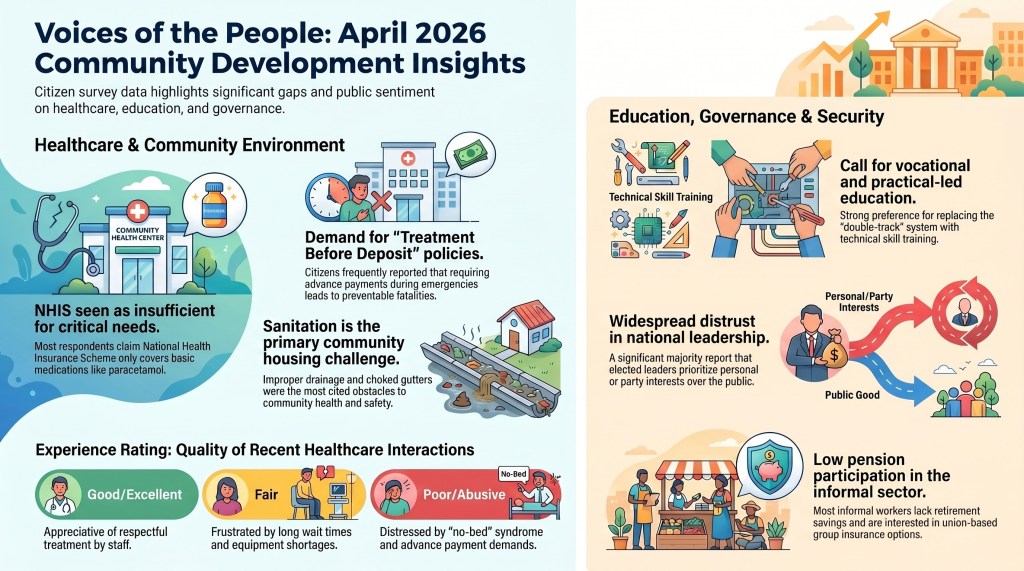
The National Health Insurance Scheme (NHIS) was intended to be a safety net, but across Nungua and beyond, it has become a symbol of inadequacy. While many still carry the card, there is a pervasive belief that the insurance is functionally limited to the most basic treatments, creating what many call a “paracetamol only” healthcare culture.
“He should know that the health insurance card is not helping, the most it does is to cover for paracetamol.”
This perception triggers a lethal cycle of medical avoidance. When citizens believe their insurance will not cover necessary medications or lab tests, the value proposition of the scheme collapses. They stop renewing their cards and avoid care until conditions become critical—shifting the burden from preventative health to expensive, often late-stage crisis management.
2. The Lethal “Deposit Before Treatment” Standard
The report uncovers a heartbreaking and frequently fatal barrier in emergency care: the requirement for advance payment. In life-or-death situations, respondents highlighted a culture where medical intervention is often delayed until a financial deposit is secured. This “payment-first” standard effectively renders the very word “Emergency” hollow.
A Financial Barrier to Survival This isn’t merely a procedural grievance; it is a systemic failure with irreversible consequences. The survey data contains harrowing evidence of how this policy shatters lives, prioritizing transactions over heartbeats.
“My young son is now paralyzed just because a deposit was needed before spinal surgery. This must change!”
When survival is gated by an immediate cash deposit, the concept of public healthcare as a right is replaced by a pay-to-play model that many simply cannot afford.
3. The Unexpected Return to the Land in Education
While the global discourse focuses on the “digital divide,” respondents in this survey expressed a counter-intuitive demand: a return to vocational roots and “forced” agriculture. There is a deep-seated feeling that the current system produces graduates without “technical know-how,” leading to calls for a more practical, even compulsory, focus on the land.
Frustrations with the “Double Track” system remain high, but the complaints go deeper into the day-to-day mechanics of the classroom:
- The Double-track system: Viewed as a fundamental obstacle to consistent, high-quality learning.
- Systemic Digital Distractions: Concerns go beyond “kids on phones.” Teachers now send assignments via WhatsApp, forcing students into a digital loop where legitimate schoolwork is indistinguishable from distraction.
- The Practicality Gap: A demand for social equity in tools. Respondents noted that while science students might have access to labs, it should be “fair for all” to have the practical equipment needed to experiment alongside theory.
4. Children as the Ultimate Pension Plan
Financial security in old age is no longer a matter of trust in the state; it is a matter of family. Due to a profound mistrust of the formal pension system—mirrored by “moderate to no trust” in the Electoral Commission and national leadership—citizens are opting out of formal retirement structures.
The data suggests that for many, a child is the only reliable social security model left. If the state cannot be trusted to count a vote or manage a local school, it is not trusted to guard a pension.
“Returns on my greatest investment, my children.”
This strategy, however, is increasingly fragile. As noted in the cost-of-living data, these same children are entering an economy of high rent and stagnant wages, creating a precarious future for both generations.
5. The Housing Crisis Isn’t Just About Roofs—It’s About Gutters
When discussing housing, the conversation usually stops at “affordability.” Yet, for residents in the HON Report, the biggest challenge isn’t just the building itself; it’s the sanitation infrastructure surrounding it. High rent is a burden, but it is the environment—the “mosquito breeding grounds” and the stench of neglect—that makes a house a cage.
The top three sanitation and housing complaints are visceral and urgent:
- Choked Gutters: Stagnant water that serves as a nursery for disease and makes streets impassable.
- Visceral Pollution: The pervasive “air pollution from public washrooms” and domestic waste poured directly into the streets.
- Improper Construction: A lack of community planning that leads to buildings erected without drainage, ensuring floods with every rain.
Conclusion: A Question for the Minister
The messages sent to the Minister of Health and other leaders are not merely requests for more buildings. They are demands for quality, respect, and accountability. The citizens from Okaishie to Labone are asking for a system that values their lives before their deposits and their skills before their certificates.
As we look at the trajectory of our national development, we must confront the reality on the ground: If we are building a nation where a health insurance card only buys a paracetamol and a child is the only reliable pension, what are we really developing?
 Mind the GAP
Leave a comment