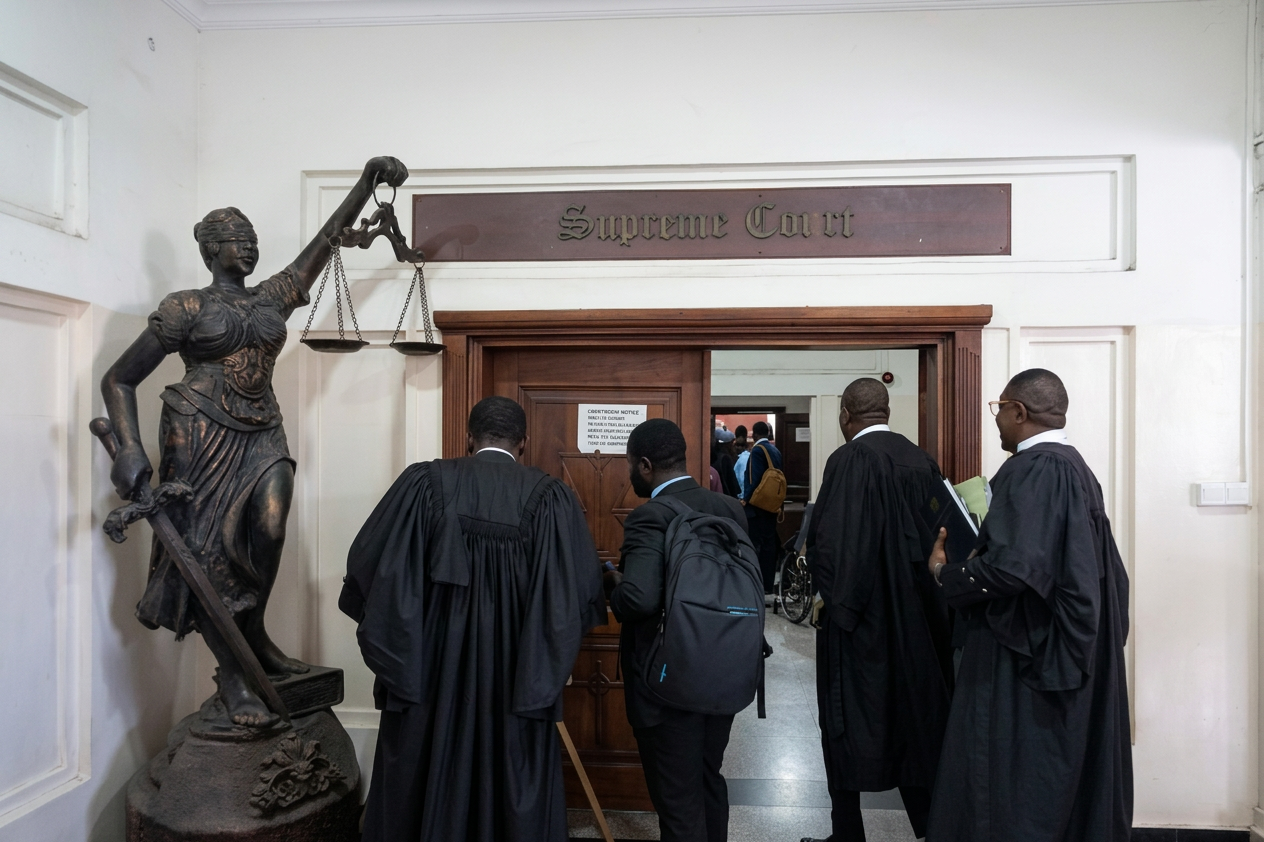
Charlatans in legal robes do not appear suddenly; they are produced, slowly and confidently, by a culture that mistakes technical proficiency for wisdom and calls bias “jurisprudence” with a straight face.
In the recent acquittal of the former MASLOC boss, the conversation among some judges and lawyers has become less about justice and more about the celebration of legal cleverness. The ordinary Ghanaian hears the facts and instinctively grasps their meaning. Certain members of the legal fraternity hear the same facts and respond with a cascade of doctrine, precedent and interpretive tricks, as though the point of law were to make the obvious unintelligible.
Consider the blunt outline that any citizen can follow.
A state official, entrusted with public funds, sends money in her charge to a financial institution without Board approval. The institution has not even requested the funds. There is no clear policy, no documented need, no authorisation traceable to the governing body tasked with oversight. The money simply moves—because an individual in power decides that it should. To the ordinary Ghanaian, this is already improper. State money is not pocket change to be “placed” wherever an official sees fit.
Then the institution seeks to return the money.
Instead of an institutional process—refunds through the banking system, transparent documentation, the involvement of the Board or auditors—the official instructs them to bring cash. Physical cash. It is handed over not to an independent cashier or treasury department, but to the official herself. A secretary issues a receipt. A signature is produced in court. And after the cash leaves the institution, it vanishes. There is no trace of it in the accounts of the state.
If you tell this story to a child, the child will understand what went wrong. The sequence is simple: unauthorised movement of public money into a private channel; attempted return; conversion of the return into cash; disappearance. No amount of Latin phrases or case citations can turn this into an example of upright stewardship. It is, at best, reckless and contemptuous of the safeguards that exist to prevent exactly this kind of behaviour. At worst, it is a deft way of turning public funds into unaccountable private disposition.
Yet, in the aftermath of the acquittal, some voices in Ghana’s legal community have begun to treat the case as an occasion for admiration: for the appellate judges who “found” a path to exoneration; for the lawyers who praise the reasoning as an example of sophisticated legal analysis. They wrap the conduct in doctrinal coverings—intent, evidentiary standards, procedural defects—until the underlying story is almost unrecognisable.
This is what happens when law is divorced from wisdom.
Law, at its best, is the institutionalisation of moral insight: a way of turning the intuition that certain acts are harmful, unjust, corrupt, or dangerous into rules that can be applied fairly to everyone. Wisdom precedes law. It is the sense, shared by ordinary people, that you do not take what is not yours, that you do not treat public office as a licence to play with public funds, that you do not hide accountability behind technicalities.
Charlatans in legal robes do the opposite. They begin not with wisdom but with allegiance—to colleagues, to factions, to habits of deference—and then search the law for anything that can be stretched to fit their desired outcome. They treat legal doctrine as a toolbox for rationalisation. If the facts point in one direction and professional loyalties point in another, it is the facts that must be reinterpreted. The audience is instructed to admire this manoeuvre as “higher learning.”
The result is a kind of intellectual theatre in which obvious impropriety is recast as innocent, or at least not quite punishable, simply because someone has managed to map it onto a set of rules in a creative way. The judges who deliver such decisions, and the lawyers who rush to applaud them, are not neutral technicians; they are participants in the slow corrosion of public trust.
There is a religious analogy here that Ghanaian society knows too well. Scripture, like law, can be read humbly or manipulated skillfully. Entire industries of preaching have grown around the art of twisting Bible verses to validate private desires, institutional excesses, and personal greed. The text is the same; what changes is the reader’s intention. When a preacher decides that his whim is righteous, he will always find a verse to support it.
In this case, the judges and their defending lawyers are doing something similar. They take the bare facts—the unauthorised movement of money, the cash return, the vanishing funds—and, instead of beginning from the wisdom that sees this as fundamentally wrong, they begin from the desire to acquit. From that starting point, the law becomes a scripture to be mined selectively. Every ambiguity is magnified. Every technical weakness in the prosecution’s case is elevated above the common-sense understanding of what happened. The judgment is then presented as an object of admiration, a triumph of careful legal reasoning over “emotional” public reactions.
The ordinary Ghanaian is asked to accept that they simply do not understand. That if only they had studied long enough and read deeply enough, they too would see the innocence in a sequence of events that, to them, looks like the textbook definition of abuse of office. They are told that justice is not about what feels wrong, but about what can be proven within the narrow confines of a system whose complexity they are not qualified to critique.
This is not humility before the law; it is arrogance behind a curtain.
To insist that justice must look like this—that it must routinely confound ordinary wisdom in order to be considered “proper”—is to invite citizens to conclude that the law is no longer theirs. It belongs to a caste of experts who can declare white to be black and failure to be triumph, so long as they can produce enough footnotes. The robe becomes not a symbol of service but a costume of impunity.
There is, of course, a legitimate place for expertise. Trials must be fair. Evidence must be weighed carefully. Not every story that sounds wrong at first hearing is, in fact, criminal. But when expertise is consistently deployed to rescue powerful actors from the consequences of plainly improper conduct, it ceases to be expertise. It becomes craft—an art of escape, honed over time and draped in the vocabulary of law.
The MASLOC judgment, and the applause surrounding it in some corners of the legal establishment, feels like a symptom of a deeper sickness: a judiciary and legal culture too comfortable with the idea that the law is a game for insiders, in which victory is measured not by alignment with justice but by the cleverness of the path taken to get there. The more detached the outcome is from ordinary moral intuition, the more it is admired as “sophisticated.”
Charlatans in legal robes thrive in such an environment. They know that as long as they can speak the language of doctrine and procedure, they can dismiss the anger of citizens as ignorance. They can call wisdom “populism,” treat moral clarity as “sentiment,” and portray their own manipulations as the sober application of rules. The robe, the titles, the citations—all of it becomes a disguise for the simple fact that, when confronted with an official who moved public money without proper approval and presided over its disappearance, they chose not to hold her to account.
It is that choice, not the length of the judgment or the elegance of its argument, that defines them.
 Mind the GAP
Leave a comment